



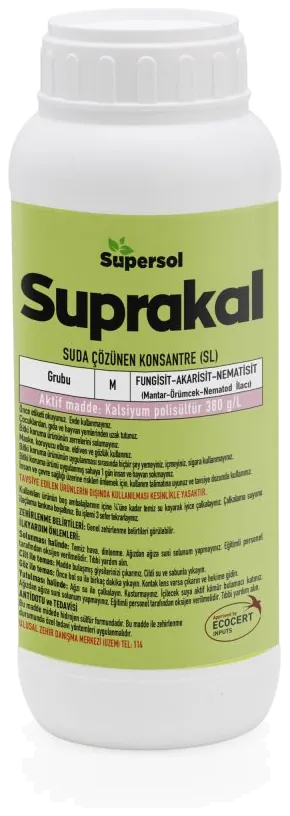
SUPRAKAL
Fungicide, acaricide, nematicide
Target plants and pests
da: decare, 1000 m².
| Plant | Pest or disease | Dose |
|---|---|---|
| Apple | Apple scab (Venturia inaequalis) | First spray2000 ml/100 LSecond1000 ml/100 LThird800 ml/100 LLater sprays400 ml/100 L |
| Vineyard | Grape powdery mildew (Erysiphe necator) | First spray1000 ml/100 LSecond800 ml/100 LThird and later400 ml/100 L |
| Hazelnut | Powdery mildew (Erysiphe sp.) | 500 ml/100 L |
| Hazelnut | Big bud mite (Phytoptus avellanae, Cecidophyopsis vermiformis) | 500 ml/100 L |
| Tomato | Powdery mildew (Erysiphe heracleid, Leveillula taurica) | 300 ml/100 L |
| Tomato | Broad mite (Polyphagotarsonemus latus) | 300 ml/100 L |
| Tomato | Root-knot nematode (Meloidogyne spp.) | 30 L/da, with solarization |
| Tomato | Red spider mite (Tetranychus spp.) | Greenhouse350 ml/100 LField350 ml/da |
| Banana (greenhouse) | Spiral nematode (Helicotylenchus multicinctus) | 7 L/da |
| Citrus | Red spider mite (Panonychus citri) | 400 ml/100 L |
| Wheat | Powdery mildew (Erysiphe graminis) | 300 ml/da |
| Wheat | Stripe (yellow) rust (Puccinia striiformis) | 300 ml/da |
| Wheat | Leaf spot (Septoria tritici) | 300 ml/da |
Mode of action
- Curative effect: an alkaline reaction from its high pH (about 11.2).
- It saponifies the lipids of the cell wall, so it passes through the wall more easily.
- Preventive effect: it interferes with the citric acid cycle of the fungus.
Properties and benefits
- Strong curative effect during the primary ascospore period of scab.
- Curative effect against peach leaf curl (Taphrina deformans), plum rust (Tranzschelia pruni), cherry leaf spot (Blumeriella jaapii) and shot hole disease (Coryneum).
- Comparable to chemical curative plant protection products, and can replace a chemical curative product that no longer works because of resistance.
- No risk of resistance, because its mode of action is not specific.
- Leaves no residue.
- Helps prevent resistance when used in programs with conventional fungicides.
- Good side effect on Marssonina, sooty blotch and powdery mildew.
- Good side effect on mites.
Time of application
Citrus red spider mite: In citrus orchards in spring, from late February to early March, count the moving mites on the upper and lower leaf surfaces with a magnifying glass. If there are more than 4 to 9 live mites on ten leaves, spray. Spraying can also be done a week after fruit set.
Root-knot nematode in tomato: Applied with soil solarization. Wet the soil thoroughly, then cover the surface with clear plastic so the gas cannot escape. Apply SUPRAKAL through the drip irrigation system to a depth of 20-25 cm, with no more than 5% SUPRAKAL in the prepared solution. Keep the solarization for at least 2 to 4 weeks.
Spiral nematode in banana: Spray first when the plant has 3 to 4 leaves above ground, again when the first bunch forms, and a third time when the fruit clusters form. Repeat each application 3 times, 10 days apart.
Broad mite in greenhouse vegetables: Pick 30 plants at random across the greenhouse and take one leaf from the upper part and one from the middle of each. Spray when counts show 4 to 5 live mites per leaf.
Powdery mildew: If the disease appears in the orchard for the first time, start spraying as soon as symptoms show. If it was seen in previous years, start at fruit set. Repeat until harvest, according to how severe the disease is, the weather and how long the product stays effective.
Big bud mite in hazelnut: Between April and May, when shoots have 4 to 4.5 leaves, new buds are half the size of a pinhead and young nuts are the size of a lentil (about 3 mm across), spray at the end of April or early May if there are on average 5 infested buds per branch.
Powdery mildew in tomato, field and greenhouse: Spray when the first signs of the disease appear, in the field or the greenhouse. Repeat according to how severe the disease is, the weather and how long the product stays effective.
Cautions and warnings
- Calibrate the sprayer before use.
- Adjust the amount of mixture to the area being treated.
- Do not apply on days or at hours when the air temperature is above 25°C.
- If the water has a high bicarbonate content, let it stand for 2 hours, then add SUPRAKAL and mix thoroughly.
- If the water has a high bicarbonate content, clean the pipes with nitric acid after use.
- For soil solarization: after wetting the soil thoroughly, cover the whole surface with clear plastic to keep the gas in. SUPRAKAL is applied through drip irrigation to a depth of 20-25 cm, with no more than 2% SUPRAKAL in the prepared mixture. Test on one valve before treating the whole drip system.